
 Gmail
Gmail Why Are My Business Emails Going to Spam? Causes, Fixes, and Solutions
Emails are one of the most important tools of communication that businesses use nowadays—yet one of the most fragile. If an important email ends up in spam, the company loses leads, payment, connection with the customer, and other chances for business success.
Many businesses face a frustrating challenge: legitimate emails end up in spam folders instead of reducing customer inboxes. Well-crafted emails may be flagged by email providers if there is any problem with authentication, reputation, or the email itself.
Most often, the cause of business emails being marked as spam is not accidental either—it is poor authentication, bad email infrastructure, and incorrect email sending procedures that are viewed as spam by email services.
Understanding these hidden causes helps solve email deliverability issues and ensure that emails always get delivered to the right destination.
Based on our experience with handling business email systems, some of the frequent causes why emails end up in spam folders are failure of email authentication, low reputation of sender, and inconsistency in sending emails. Resolving these problems early will greatly increase the success of email delivery.
Why Emails Are Not Reaching the Inbox
Email service providers like Gmail, Outlook, and Yahoo have complex filtering mechanisms that help safeguard customers against spam, phishing, and other malicious content. Every email is evaluated depending on who sent the message, their reputation, the server that sends the message, and its content.
If there are no sufficient trust indicators, an email will be delivered directly into the spam folder. This is why many organizations experience emails landing in spam folder despite sending legitimate business communications.
The primary requirement is trust. Emails with no sufficient trust signals are considered unsafe by default.
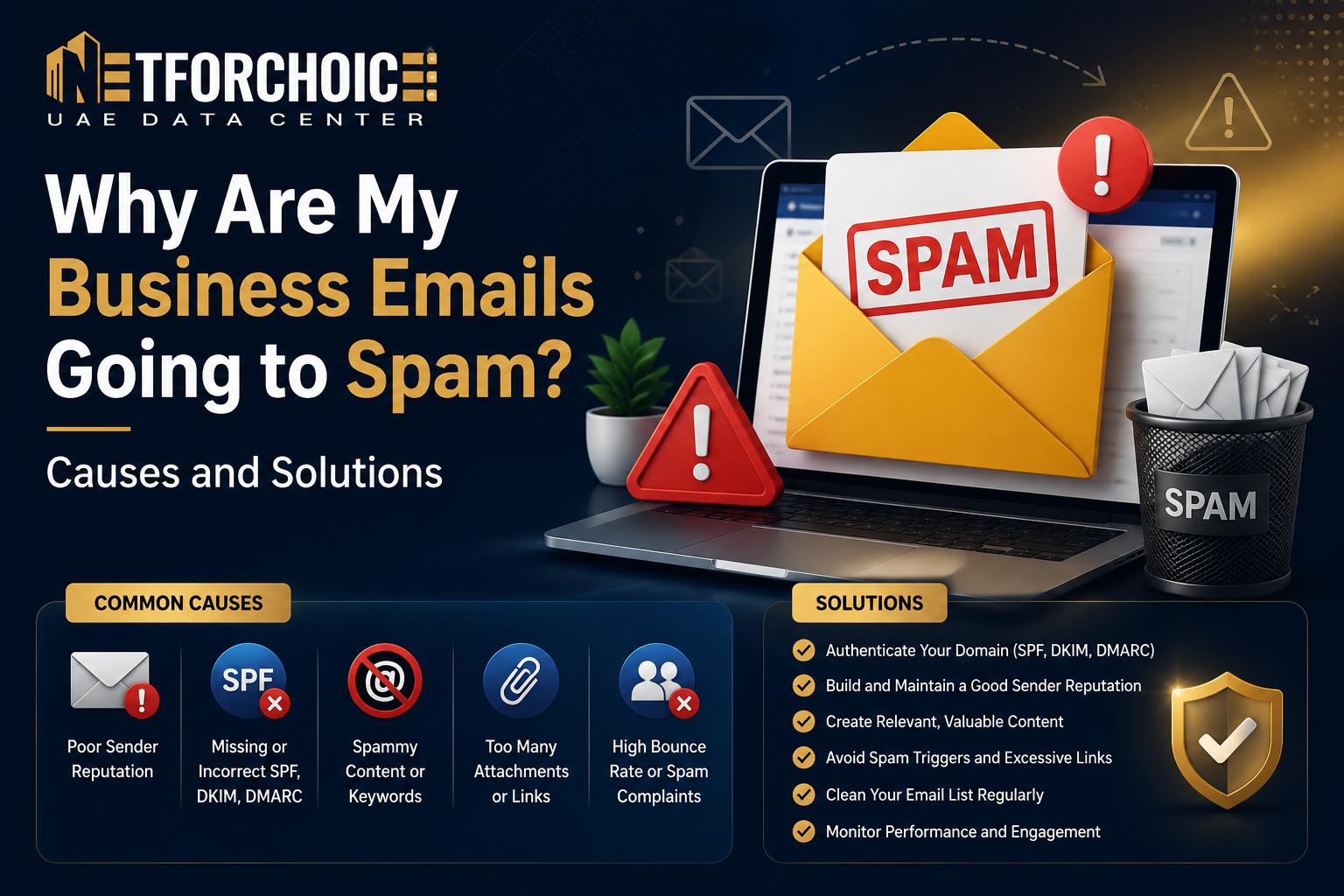
Common Causes of Business Email Spam Problems
Most business email spam problems originate from authentication problems, poor sender reputation, email infrastructure problems, or sending inconsistencies.
- No Email Authentication Configurations:
A key technical cause behind email spam issues involves having no email authentication.
For authenticating emails, the server has to configure SPF, DKIM, and DMARC settings.
If your server does not include these email authentication settings, your emails can face a lot of difficulties while delivering since the email provider will be unable to authenticate your emails and might consider them spam emails.
The standard practice in the industry reveals that the inbox placement rate of the authenticated domains is higher compared to non-authenticated domains since providers trust the sender’s information.
Proper email authentication plays an integral role in ensuring email security, legitimacy, and domain reputation.
- Weak Domain Reputation:
Every email domain develops a reputation based on how emails are sent, delivered, and received.
New domains and poorly managed email environments often take longer to establish trust with mailbox providers.
If the sending pattern of your domain is unreliable, has high bounce rate, or gets many spam complaints, it directly leads to business emails going to spam.
After experiencing a bad reputation, it takes time to repair it with constant improvements.
- Lack of Secure Email Infrastructure:
Your email hosting platform is one of the key determinants of email deliverability.
Selecting secure business email hosting services from NetForChoice ensures improved email deliverability through reliable email server infrastructure built specifically for business purposes.
Lack of adequate security in your email hosting infrastructure could lead to failure of correctly configured emails to be delivered to inboxes.
- Spam Triggering Content:
Email content is scrutinized via active scans through spam filters that rely on artificial intelligence for email filtering.
If the content consists of excessive promotional content, a misleading email subject line, too many links in the message, or poor formatting, then these emails will probably be blocked.
They result in deliverability problems and become more likely during marketing email campaigns or automated mailing.
- Improper Sending Behavior:
Sudden increases in email volumes or sending bulk emails using a brand new domain without establishing yourself first may cause emails being considered spam.
Sending behaviour should always be steady for email accounts; otherwise, it will trigger spam filters.
As a result, many businesses unknowingly experience spam placement issues despite sending legitimate emails.
Proven Solutions to Improve Email Deliverability
Solving the problem of spam will involve implementing a systematic process involving authentication, infrastructures, and correct email practices.
- Use Reliable Email Authentication
Email authentication is the key foundation of any email program.
At NetForChoice, we offer a full service suite in regards to email authentication solutions, including:
- SPF (Sender Policy Framework)
- DKIM (DomainKeys Identified Mail)
- DMARC (Domain-based Message Authentication and Reporting)
These methods guarantee that the sender is authenticated and secure from any malicious users trying to exploit the domain.
Their proper implementation helps resolve deliverability problems and forms the foundation of effective email authentication solutions.
- Have a Secure Business Email Hosting Service by NetForChoice:
Having a reliable hosting service is crucial for ensuring stable performance of emails.
NetForChoice has a secure business email hosting service, which is designed with top-class security services, spam filters, and server reputation optimization.
This includes:
- Reliable email delivery
- Decreased spam filtering
- Encrypted message transfers
- Enhanced domain trust indicators
These are all crucial aspects for today’s modern companies.
- Inbuilt Monitor for Email Performance Optimization:
NetForChoice has an email infrastructure management service that allows organizations to monitor email performance through hosting itself.
This means that users can monitor:
- Email delivery success
- Spam filtering success
- Domain health
- Server reputation
This allows businesses to identify email deliverability issues quickly and take corrective action before communication is affected.
- Warm up your email sending gradually:
It is very important for new domains to send emails gradually.
Sending email gradually means sending smaller quantities initially targeting only those who engage and then increasing their number.
Gradual sending will help build trust with email providers and will decrease chances of your business emails getting into spam due to activation of spam filters.
Why Authentication and Hosting Must Work Together
Most companies usually attempt to address issues associated with deliverability either from an infrastructural or behavioral perspective. However, the best way to achieve success is through optimizing both technical and infrastructural aspects.
An advanced email authentication tool will help verify and trust your domain, while business email hosting will help deliver your emails via reliable infrastructure.
Both tools will greatly reduce spam and will lead to building a stable and sustainable email environment.
Real-Life Example
An organization initiates an email marketing campaign without appropriate authentication or infrastructure. Thousands of emails are sent out on the very first day.
If the information provided within the email is both pertinent and well-written, the email providers will identify:
- Non-authenticated identity of the sender’s domain
- Unusually large volume of emails being sent out at once
- Inadequate response rate
Consequently, these emails are automatically labelled as spam or rejected.
Conclusion
In the case where an organization experiences difficulties with business emails being marked as spam, it is likely that this problem will never stem from a single reason. It will typically come down to missing authentication, a poorly constructed infrastructure, and the wrong approach to sending emails.
Through effective email authentication, improved sending practices, and the use of business email services by NetForChoice, organizations will find themselves able to enjoy improved deliverability and inbox delivery.
At NetForChoice, our email service offers a complete and safe email environment which can be expected to solve all problems related to email deliverability.
In modern times, having an efficient email foundation is more than necessary for businesses to thrive in the current market.
FAQ’S:
1. Why are my business emails going to spam instead of the inbox?
Business emails often go to spam due to missing email authentication records (SPF, DKIM, and DMARC), poor domain reputation, spam-triggering content, or unreliable email hosting infrastructure. Proper configuration and monitoring can significantly improve email deliverability.
2. How do SPF, DKIM, and DMARC help improve email deliverability?
SPF, DKIM, and DMARC verify that emails are sent from authorized servers and have not been altered during transmission. These authentication protocols help email providers trust your domain, reducing the chances of emails being marked as spam.
3. Can business email hosting services reduce spam issues?
Yes. Reliable business email hosting services provide secure infrastructure, optimized server reputation, email security features, and better email delivery management, helping legitimate emails reach the recipient’s inbox more consistently.
4. What are the best practices to prevent emails from landing in spam folders?
To prevent emails from going to spam, configure SPF, DKIM, and DMARC records, maintain a good sender reputation, avoid spammy content, send emails consistently, clean your mailing lists regularly, and monitor email performance metrics.
5. How does Backup & Recovery help protect business email data?
Backup & Recovery helps safeguard business email data from accidental deletion, cyberattacks, ransomware, hardware failures, and data loss. By storing secure copies of emails and attachments in the cloud, businesses can quickly recover critical communications and maintain business continuity.




Why Enterprise Email Hosting UAE Businesses Need in 2026
February 26, 2026