
 cyber security, cyber threats, NOC, NOC service, SOC, SOC service
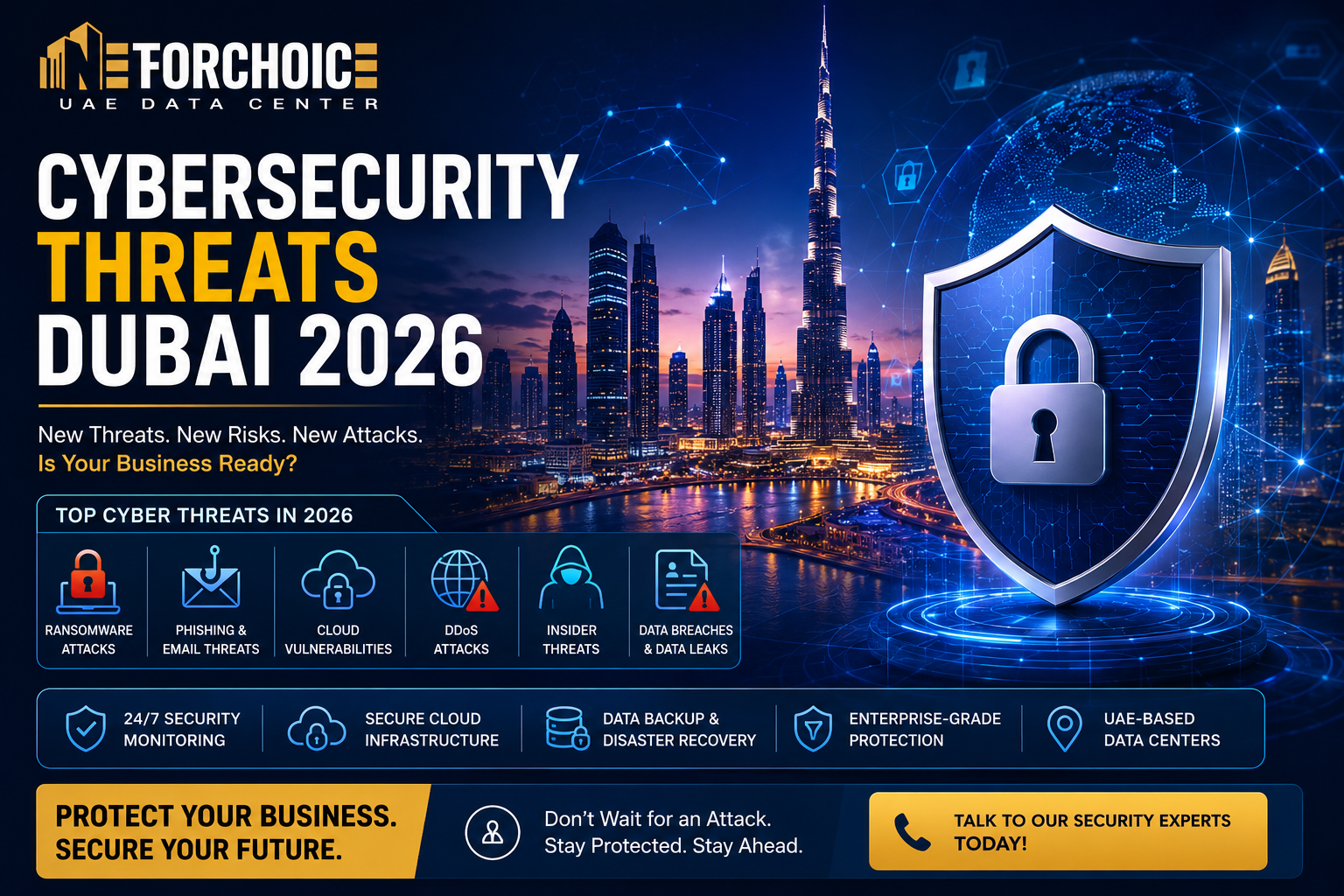
 Top 7 Cybersecurity Threats Facing Dubai Businesses in 2026 – And How to Protect Yours
Published: May 2026 | Reading Time: 11 Minutes | Last Reviewed: May 2026
Key Takeaway: The UAE faces over 200,000 cyberattacks every single day. A single data breach in the Middle East costs an average of $7.29 million — the second highest in the world. If your Dubai business is connected to the internet, this guide is for you. We break down the 7 most dangerous threats of 2026, show you exactly how each one works, and give you a clear action plan to protect your operations — starting today.
Why Dubai Businesses Are Prime Targets in 2026
Dubai is one of the most connected business cities on the planet. That is precisely why it is also one of the most targeted.
Financial services, logistics, real estate, healthcare, e-commerce — the wealth of industries operating in the UAE makes it an attractive destination for cybercriminals looking for high-value targets. And the numbers confirm this is not a hypothetical risk.
According to the UAE Cyber Security Council, the country experiences more than 200,000 cyberattacks per day [SOURCE: UAE Cyber Security Council, 2026]. IBM’s Cost of a Data Breach Report places the Middle East’s average breach cost at $7.29 million — second only to the United States [SOURCE: IBM Cost of a Data Breach Report, 2025].
In the first six weeks of 2026 alone, 128 confirmed cyber incidents were recorded against UAE entities.
These are not isolated events. They are a pattern — and that pattern is accelerating.
The UAE cybersecurity market is currently valued at $0.91 billion and projected to reach $1.51 billion by 2031 [SOURCE: Mordor Intelligence UAE Cybersecurity Market Report, 2026], reflecting just how seriously businesses and government are now investing in digital defense.
The question every Dubai business owner needs to ask is not whether they will be targeted. The question is whether they will be prepared when it happens.
Threat Snapshot: Dubai’s Cybersecurity Landscape at a Glance
Before diving into each threat, here is a quick overview of what businesses in the UAE are dealing with in 2026:
Threat #1 — Ransomware: The Most Financially Devastating Attack in the UAE
What It Is
Ransomware is a type of malicious software that encrypts all of your business data — making it completely inaccessible. Attackers then demand a ransom payment, typically in cryptocurrency, in exchange for the decryption key.
In 2026, the threat has evolved significantly. Modern ransomware attacks in the UAE now employ double extortion — attackers not only lock your data but also threaten to publish it publicly unless payment is received. This means that even if you have backups, the threat of a public data leak puts your reputation and customer relationships at serious risk.
The Numbers
- Ransomware attacks in the UAE increased by 32% between 2024 and 2026 [SOURCE: Kaspersky Middle East Threat Report, 2025]
- The median ransom demand globally stands at $2.73 million, with remediation and downtime costs pushing the average ransomware incident beyond $5 million [SOURCE: IBM, 2025]
- Ransomware was involved in 44% of all breaches globally in 2025 — up from 32% the year prior
Who It Targets in Dubai
Healthcare providers, logistics and supply chain companies, real estate firms, and financial services organizations are the primary targets — because operational disruption in these sectors creates immediate pressure to pay.
A Real-World Example
In early 2026, a Dubai-based logistics firm was struck by ransomware over a weekend. By Monday morning, their entire operations management system was encrypted. With shipments pending and contracts at risk, they faced a choice: pay the ransom or spend weeks rebuilding from scratch. The incident cost them over AED 800,000 in downtime losses alone — before even factoring in the ransom demand.
How to Protect Your Business
- Implement the 3-2-1 backup rule: 3 copies of your data, on 2 different media types, with 1 copy stored offsite or in a secure cloud environment
- Deploy Endpoint Detection and Response (EDR) tools that use behavioral AI to catch ransomware before it executes
- Run regular backup restoration tests — an untested backup is not a reliable backup
- Ensure critical backups are immutable — stored in a way that attackers cannot encrypt or delete them
- NetForChoice Cyber Security Solutions provides UAE-based, isolated backup infrastructure specifically designed to protect against ransomware scenarios
Threat #2 — Phishing & AI-Powered Email Scams
What It Is
Phishing is the practice of sending deceptive communications — typically emails — that trick recipients into revealing credentials, clicking malicious links, or installing malware. In 2026, phishing is no longer limited to poorly-written generic emails. It has become frighteningly sophisticated.
Attackers now use generative AI to craft highly personalized emails that perfectly mimic the tone and style of your CEO, your bank, or your most trusted vendors. More alarmingly, Adversary-in-the-Middle (AiTM) phishing attacks can now intercept authentication tokens and bypass Multi-Factor Authentication (MFA) entirely — meaning even organizations with MFA enabled are not automatically protected.
The Numbers
- 75% of cyber breaches in the UAE start with a phishing email [SOURCE: UAE Cyber Security Council, 2026]
- 62% of phishing landing pages are fully branded — impersonating Microsoft, Google, DHL, or internal company systems — making them extremely difficult for staff to identify [SOURCE: KnowBe4 Phishing Report, 2025]
- Phishing is now the #1 initial attack vector, overtaking stolen credentials for the first time in 2025 [SOURCE: Verizon DBIR, 2025]
Who It Targets in Dubai
Every business in the UAE using email is a target. However, Microsoft 365 and Google Workspace users face elevated risk, as attackers specifically design phishing pages that replicate these platforms’ login interfaces with pixel-perfect accuracy.
How to Protect Your Business
- Deploy advanced email filtering with anti-spoofing, safe-link scanning, and attachment sandboxing
- Implement FIDO2 hardware security keys or UAE Pass integration as MFA — standard SMS-based MFA is no longer sufficient against AiTM attacks
- Configure SPF, DKIM, and DMARC DNS records to prevent email domain spoofing
- Train staff with simulated phishing exercises quarterly — human behavior is the entry point for 88% of all cyber incidents [SOURCE: IBM, 2025]
- NetForChoice Secure Email Hosting includes built-in anti-phishing filters and enterprise-grade spam protection
Threat #3 — Business Email Compromise (BEC): The Silent Financial Thief
What It Is
Business Email Compromise is one of the most financially impactful cyber threats facing UAE businesses — and it involves no malware whatsoever. No viruses. No hacking of technical systems.
It is pure social engineering.
An attacker either gains access to a real executive email account or creates a convincing impersonation of one. They then target your finance team, your accounts payable department, or a trusted supplier — requesting an urgent wire transfer or a change in payment details.
Because the request appears to come from a known and trusted sender, employees comply.
The Numbers
- BEC is the fastest-growing cybercrime category in the UAE in 2026
- Globally, BEC attacks resulted in $2.9 billion in losses in 2023, a figure that has continued to climb [SOURCE: FBI Internet Crime Report]
- A Dubai-based company lost AED 2.3 million in a single BEC incident in January 2026 — the finance manager processed the transfer believing it was a legitimate CEO instruction [SOURCE: factosecure.com UAE Cybersecurity Report, 2026]
Who It Targets in Dubai
Finance teams, C-suite executives, accounts payable departments, and businesses engaged in international B2B transactions are the primary targets. The UAE’s high volume of cross-border transactions makes BEC particularly lucrative for attackers operating in this region.
How to Protect Your Business
- Establish a mandatory verbal verification process for all payment requests above a defined threshold — regardless of how legitimate the email appears
- Never change bank account details based solely on an email instruction
- Train finance staff specifically on BEC patterns — fake invoice fraud, CEO impersonation, and supplier account hijacking
- Implement email header analysis tools that flag external emails impersonating internal addresses
- NetForChoice Hybrid Mail Service with anti-spoofing protection
Threat #4 — Data Breaches & Unauthorized Access: The Invisible Intruder
What It Is
Many of the most damaging cyberattacks do not involve dramatic ransom screens or obvious disruption. An attacker quietly gains access to your systems using stolen credentials, moves laterally across your network for weeks or months, and silently extracts sensitive data — customer records, financial information, intellectual property — without triggering any alarms.
By the time the breach is discovered, significant damage has already been done.
The average time to identify and contain a breach in 2025 was 241 days [SOURCE: IBM Cost of a Data Breach Report, 2025]. That is eight months of undetected access to your business data.
The UAE-Specific Risk: PDPL Compliance
In 2026, data breaches carry a new layer of risk for UAE businesses. The Personal Data Protection Law (PDPL) is now fully active, and non-compliance carries fines of up to AED 20 million for severe violations. Under PDPL, any business collecting, storing, or processing personal data of UAE residents must ensure that data is stored securely and, critically, within UAE borders where required.
This means where you host your data matters as much as how you secure it.
The IBM X-Force Threat Intelligence Index ranked the UAE fourth globally for cyberattacks, accounting for 10% of all global incidents in 2024 — reinforcing just how exposed UAE-based data is to unauthorized access attempts.
How to Protect Your Business
- Enforce Multi-Factor Authentication (MFA) across all systems — not just email
- Conduct regular access reviews — remove credentials for former employees immediately and apply least-privilege principles
- Store sensitive data with a UAE-based, PDPL-compliant hosting provider to meet data residency requirements
- Implement SIEM (Security Information and Event Management) tools for real-time anomaly detection
- NetForChoice UAE Data Center — ISO 27001 certified, PDPL-compliant infrastructure, Tier III security
Threat #5 — DDoS Attacks: Taking Your Business Offline
What It Is
A Distributed Denial of Service (DDoS) attack floods your web server or network with an overwhelming volume of fake traffic — far beyond what your infrastructure can handle. The result is simple: your website, application, or online service goes offline.
For e-commerce businesses, a few hours of downtime during a peak period — Ramadan, UAE National Day, Dubai Shopping Festival — can mean tens of thousands of AED in lost revenue. For SaaS companies and digital services, the damage to customer trust can be longer-lasting than the outage itself.
DDoS attacks in 2026 are also used as a smokescreen — while your team scrambles to restore services, attackers exploit the distraction to breach other parts of your network.
Who It Targets in Dubai
E-commerce platforms, financial services, government portals, and any business with a customer-facing web presence. Competitors occasionally commission DDoS attacks against rivals during peak commercial seasons — a growing concern in Dubai’s competitive retail and hospitality sectors.
How to Protect Your Business
- Choose a hosting provider with native DDoS protection — this is non-negotiable for any business-critical web presence
- Implement a Content Delivery Network (CDN) to absorb and distribute traffic spikes
- Ensure your hosting infrastructure includes traffic scrubbing and rate limiting capabilities
- Have an incident response plan in place specifically for availability events
- NetForChoice DDoS-Protected Hosting Plans — enterprise-grade mitigation built into all server infrastructure
Threat #6 — Insider Threats: The Risk That Comes From Within
What It Is
Not every cybersecurity threat originates outside your organization. Insider threats — whether from a disgruntled employee, a careless contractor, or a well-intentioned but poorly trained staff member — represent one of the most underestimated risks for Dubai businesses.
An insider threat can be malicious (an employee deliberately stealing data before leaving) or accidental (a team member forwarding a sensitive file to the wrong email address). Both can result in significant data loss, regulatory penalties, and reputational damage.
The Numbers
- 88% of all cyber incidents involve some element of human error [SOURCE: IBM, 2025]
- 42% of business leaders report that insider activity accounts for between 1 and 24% of their security incidents [SOURCE: Viking Cloud Cybersecurity Statistics, 2025]
- Insider-driven breaches cost an average of $4.99 million — higher than the global breach average — largely because they are harder to detect and contain
The UAE SME Reality
The insider threat problem is particularly acute for SMEs, which represent 94% of all companies in the UAE. Small businesses rarely have formal access controls — most employees can access most systems — which means a single compromised or malicious insider can do enormous damage.
How to Protect Your Business
- Implement Role-Based Access Control (RBAC) — every employee should only access the systems and data their role requires
- Create a formal employee offboarding checklist — all access credentials must be revoked on the day employment ends
- Enable activity logging on critical systems to create an audit trail
- Conduct regular internal security awareness training — most accidental insider incidents are preventable with basic education
- For contractors, implement time-limited access credentials that automatically expire
Threat #7 — Supply Chain Attacks: Hacked Through a Trusted Partner
What It Is
Supply chain attacks represent one of the most significant emerging threats of 2026. Rather than targeting your organization directly — where you may have strong defenses — attackers compromise a trusted third party that has access to your systems. A software vendor. An accounting platform. A managed service provider.
Once the vendor is compromised, attackers use that trusted relationship as a backdoor into your network. You did everything right internally — but your trusted partner’s vulnerability became yours.
The Numbers
- Supply chain compromises have overtaken traditional network intrusions as the leading attack vector in the Middle East and North Africa region in 2026 [SOURCE: iConnectITBS Cybersecurity Report, 2026]
- Third-party and supply chain compromise doubled in prevalence year-over-year, now accounting for approximately 15% of all breaches globally [SOURCE: Verizon DBIR, 2025]
- In 2026, attackers are specifically targeting Initial Access Brokers (IABs) — underground operators who sell pre-established access to UAE company networks
How to Protect Your Business from Cybersecurity Threats
- Vet all vendors for their security posture before granting system access — ask for their security certifications and incident history
- Apply least-privilege access to all third-party integrations — vendors should only access what they genuinely need
- Review and audit all active third-party connections quarterly
- Monitor vendor software updates carefully before applying them to production systems
- Ensure your contracts include cybersecurity liability clauses — your vendor should share responsibility for breaches caused by their compromise.
The Real Cost of Getting It Wrong: UAE Financial Impact
Many businesses underestimate cybersecurity spend because they are comparing it against an invisible cost — the cost of a breach that has not happened yet.
Here is what a cyber incident actually costs a UAE business:
Prevention, by comparison, costs a fraction of these figures. The return on investing in proper cybersecurity infrastructure is not measured in features — it is measured in incidents that never happen.
Your 2026 Cybersecurity Action Plan: Where to Start
Addressing seven threats simultaneously can feel overwhelming. Here is a prioritized, practical roadmap for Dubai businesses at any stage of their security journey.
Month 1 — Foundation (Do These First)
- ✅ Enable MFA on all email, cloud, and business-critical platforms immediately
- ✅ Audit user access — remove former employees, review contractor access, apply least-privilege
- ✅ Verify your backups — test a restoration to confirm your backup actually works
- ✅ Move to secure hosting — if your website or application is on shared hosting, upgrade to a protected environment with DDoS mitigation
Month 2 — Email and Endpoint Security
- ✅ Deploy advanced email filtering with anti-phishing and anti-spoofing controls
- ✅ Install EDR (Endpoint Detection & Response) on all business devices
- ✅ Configure SPF, DKIM, and DMARC on your business email domain
- ✅ Run a simulated phishing exercise to assess your team’s current awareness level
Month 3 — Compliance and Monitoring
- ✅ Map your data flows — identify all personal data you collect, store, and process
- ✅ Confirm your hosting provider is PDPL-compliant and keeps UAE resident data within UAE borders
- ✅ Implement activity logging on critical systems
- ✅ Conduct a vendor access audit — review all third-party integrations
Month 4 — Training and Response Planning
- ✅ Run a company-wide security awareness training session
- ✅ Create a basic Incident Response Plan — who do you call first when an attack happens?
- ✅ Consider a professional security assessment to identify gaps your internal team may have missed
UAE Regulatory Context: What the Law Requires in 2026
Cybersecurity in the UAE is no longer purely a business decision. It is increasingly a legal obligation.
UAE National Cybersecurity Strategy (2025–2031): The UAE government has shifted from voluntary compliance to mandatory resilience. Organizations operating critical infrastructure, financial services, and government-adjacent services now face specific security control requirements.
Personal Data Protection Law (PDPL): Fully active in 2026, the PDPL requires all businesses processing UAE residents’ personal data to implement appropriate security measures, maintain data breach notification procedures, and — where specified — keep data within UAE borders. The maximum fine for serious violations is AED 20 million.
NESA Information Assurance Standards: For government entities and critical infrastructure operators, NESA IAS compliance is mandatory — covering asset management, access control, cryptography, and incident management.
DIFC and ADGM: Businesses operating within Dubai’s financial free zones are subject to their own data protection regimes, closely aligned with GDPR standards, with active regulatory enforcement.
For organizations operating across multiple of these frameworks, choosing a hosting and infrastructure partner with pre-existing compliance certifications significantly reduces the compliance burden.
How NetForChoice Protects Dubai Businesses
At NetForChoice, we understand that cybersecurity is not just an IT department concern — it is a business continuity issue.
Our infrastructure is built from the ground up to address the specific threats UAE businesses face:
- Tier III Certified Data Center in Dubai — physically secure, redundant power, and carrier-grade connectivity with 99.95% uptime SLA
- DDoS Protection — included across all our hosting and server infrastructure, with automatic traffic scrubbing and mitigation
- Secure Cloud Backup — immutable, UAE-based backup storage that ransomware cannot reach or encrypt
- ISO 27001 Certified — internationally recognized information security management
- PDPL-Compliant Infrastructure — your data stays in the UAE, meeting data residency requirements under UAE law
- 24/7 NOC/SOC Monitoring — our engineers are watching your infrastructure around the clock
- Dedicated Server Hosting UAE — full isolation from other tenants, eliminating shared-environment risks
- Cloud VPS Hosting Dubai — scalable, secure infrastructure for growing businesses
We work with businesses of all sizes across Dubai, Abu Dhabi, and the wider UAE — from start-ups setting up their first secure hosting environment to enterprises migrating complex infrastructure to a compliant UAE data center.
Frequently Asked Questions
Q: How many cyberattacks happen in the UAE every day? The UAE Cyber Security Council reports that the UAE experiences over 200,000 cyberattacks per day. In the first six weeks of 2026 alone, 128 confirmed cyber incidents were recorded against UAE organizations.
Q: What is the average cost of a data breach in the UAE? According to IBM’s Cost of a Data Breach Report 2025, the average data breach cost in the Middle East (which includes the UAE) is $7.29 million — the second highest in the world after the United States.
Q: Are small businesses in Dubai targeted by cybercriminals? Yes — increasingly so. SMEs account for 94% of all companies in the UAE, and attackers deliberately target smaller businesses precisely because they tend to have fewer security controls and less incident response capability than large enterprises.
Q: What is the UAE PDPL and does it apply to my business? The UAE Personal Data Protection Law (Federal Decree-Law No. 45 of 2021) applies to any business that collects, stores, or processes personal data of UAE residents — regardless of where the business is headquartered. It carries fines of up to AED 20 million for serious violations. Full compliance is required in 2026 with a transition period running to January 2027.
Q: Does my hosting provider affect my cybersecurity? Significantly. Your hosting provider is the foundation of your digital infrastructure. A hosting provider without DDoS protection, physical security, redundant power, and data residency compliance introduces vulnerabilities that no software tool can fully compensate for. Choosing a UAE-based, ISO 27001 certified, Tier III data center is one of the highest-impact security decisions a Dubai business can make.
Q: What should I do first to improve my business’s cybersecurity? Start with MFA on all accounts, verify your backup strategy, and ensure your web infrastructure is on a protected hosting environment. These three steps address the majority of the attack vectors described in this guide and can be implemented within 30 days.
Conclusion: Cybersecurity Is No Longer Optional for Dubai Businesses
The threat landscape for UAE businesses in 2026 is real, it is escalating, and it is expensive. A reactive approach — waiting until an incident occurs before investing in protection — consistently produces the worst financial outcomes.
The businesses that are emerging from incidents most successfully are those that treated security as a business investment rather than an IT expense. They have tested backups. They have protected infrastructure. They have trained staff. And when an attacker comes — because they will — they contain the damage in hours rather than months.
The cost of preparation is always lower than the cost of a breach.
If you are unsure how secure your current infrastructure is, start with a conversation. Our team at NetForChoice has helped hundreds of UAE businesses assess their security posture and build infrastructure that keeps them protected — and compliant.
Ready to secure your business? Talk to our UAE infrastructure experts today — the first consultation is completely free.
Sources & References
- UAE Cyber Security Council — State of UAE Cybersecurity Report 2025/2026
- IBM Security — Cost of a Data Breach Report 2025 (Ponemon Institute)
- Kaspersky — Middle East Threat Intelligence Report 2025
- Verizon — Data Breach Investigations Report (DBIR) 2025
- Mordor Intelligence — UAE Cybersecurity Market Report 2026
- KnowBe4 — Phishing by Industry Benchmarking Report 2025
- eventussecurity.com — Top 10 Recent Cyber Attacks in UAE 2026
- factosecure.com — Cybersecurity Threats Facing Businesses in UAE 2026
© 2026 NetForChoice UAE
|
Tier III Data Center, Dubai
|
ISO 27001 Certified
|
PDPL-Compliant Infrastructure

How to Protect Business Documents from Unauthorized Access?
February 10, 2026