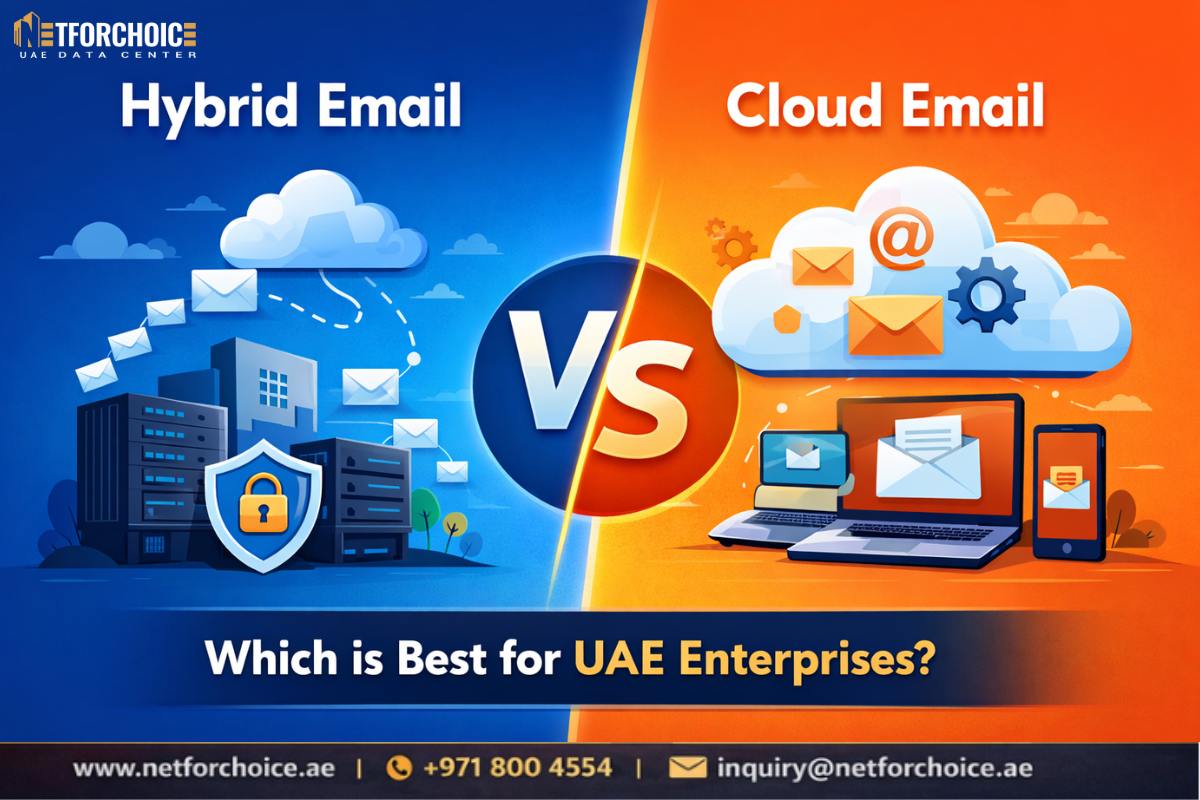
Hybrid Email Vs Cloud Email: Which Is Best for UAE Enterprises?
Email remains one of the most critical communication systems for modern enterprises. Whether it’s client communication, internal collaboration, or compliance documentation, businesses depend on reliable and secure email infrastructure to operate efficiently.
In the UAE’s rapidly evolving digital economy, organizations are increasingly evaluating different email deployment models to support business growth, security, and compliance requirements. One key debate among IT leaders is choosing between cloud-based email platforms and hybrid architectures.
Many enterprises are now exploring a hybrid email solution UAE business can adopt to combine the flexibility of cloud platforms with the control of on-premise infrastructure.
For IT managers, CIOs, and CTOs, understanding the differences between hybrid and cloud email systems is essential for making an informed technology investment. This guide explains how both approaches work, their benefits, and how enterprises in the UAE can determine which option best suits their operational needs.
What is Hybrid Email Infrastructure?
Hybrid email infrastructure is a model where organizations use both on-premise email servers and cloud-based email services together.
Instead of moving all email operations to the cloud, businesses maintain part of their email environment within their internal infrastructure while integrating it with cloud-based services.
This architecture allows organizations to:
- Keep sensitive email data within controlled environments
- Use the cloud for scalability and remote access
- Maintain greater administrative control over email systems
Hybrid deployments are commonly used by enterprises that must balance modern collaboration tools with strict security or regulatory requirements.
Core Features of Hybrid Email Hosting
- Combination of internal and cloud email systems
- Flexible workload distribution between environments
- Greater administrative control over data
- Improved disaster recovery capabilities
- Support for compliance-driven industries
For enterprises transitioning to digital transformation while still relying on legacy systems, hybrid cloud email environments provide a practical bridge between traditional and modern IT infrastructure.
What is Cloud Email Hosting?
Cloud email hosting refers to a model where the entire email infrastructure is hosted and managed by a third-party service provider.
In this setup, organizations no longer operate their own email servers. Instead, email services run on the provider’s cloud infrastructure, which handles storage, maintenance, security updates, and system availability.
Key Benefits of Cloud Email
- Minimal infrastructure management for IT teams
- Access to email services from any location
- Automatic updates and software maintenance
- Flexible subscription-based pricing
- Rapid scalability for growing organizations
Cloud email solutions are widely adopted by start-ups and mid-sized companies due to their simplicity and lower operational overhead.
However, large enterprises sometimes face challenges related to data residency, compliance control, and infrastructure customization, which is why hybrid models are gaining popularity.
Hybrid vs Cloud Email Comparison
For enterprise decision-makers, comparing both approaches across critical infrastructure factors can simplify the evaluation process.
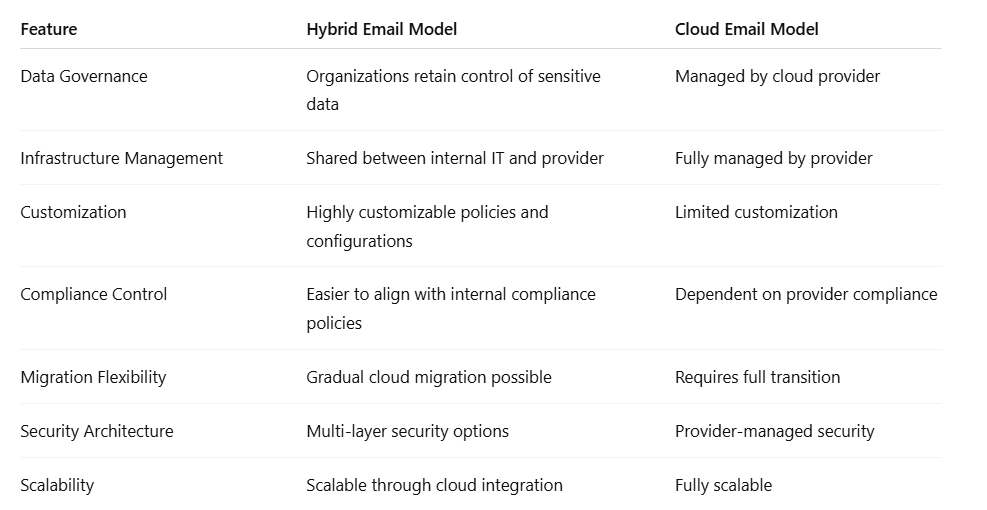
Enterprises with strict compliance policies or legacy IT infrastructure often benefit from the flexibility of hybrid deployments.
When Businesses Should Choose Hybrid Email
Not every organization requires a hybrid model. However, for many enterprises, hybrid infrastructure offers operational advantages.
Hybrid email may be the right choice when:
1. Organizations must follow regulatory policies
Certain industries require businesses to maintain data within specific environments to meet compliance standards.
2. Legacy systems are still in use
Older enterprise applications may not integrate smoothly with cloud-only email platforms.
3. Businesses want controlled cloud adoption
Hybrid deployments allow companies to migrate gradually rather than implementing a sudden infrastructure shift.
4. Advanced security policies are required
Enterprises often need custom email security frameworks tailored to internal IT governance.
5. High availability is critical
Hybrid environments improve redundancy by distributing workloads across multiple systems.
For organizations with complex IT environments, hybrid email hosting can provide greater operational resilience.
6. Security Advantages of Hybrid Email
Security is one of the biggest considerations when selecting enterprise email infrastructure.
Hybrid environments offer additional layers of protection compared to purely cloud-based deployments.
Key Security Benefits
1. Data Control
Sensitive corporate communication can remain within internal servers while general communication is managed in the cloud.
2. Advanced Policy Management
Enterprises can define custom security frameworks including:
- encryption policies
- access control mechanisms
- internal authentication rules
- network security configurations
3. Reduced Single Point of Failure
With workloads distributed across environments, businesses gain improved resilience against outages.
4. Improved Compliance Readiness
Organizations can design email architectures that meet regulatory requirements across different sectors.
For UAE enterprises handling financial, government, or healthcare data, these capabilities are particularly important.
Enterprise Use Cases in UAE
Many organizations across the UAE are already implementing hybrid email environments to support operational efficiency and security.
1. Financial Institutions
Banks and financial firms require secure communication channels while maintaining regulatory compliance. Hybrid models allow sensitive communications to remain internally controlled.
2. Government Agencies
Public sector organizations often require strict control over data management and residency. Hybrid architectures help maintain internal oversight while still benefiting from cloud scalability.
3. Healthcare Providers
Healthcare institutions handle confidential patient information and must follow strict privacy standards. Hybrid systems allow secure internal communication while enabling remote collaboration.
4. Global Enterprises
Companies with operations across multiple regions often rely on hybrid systems to balance centralized control with distributed collaboration capabilities.
How NetForChoice Supports Enterprise Email Infrastructure
For enterprises planning to deploy or upgrade their email infrastructure, working with a reliable technology partner is essential.
NetForChoice provides enterprise-grade email platforms designed to support secure communication, operational scalability, and compliance-focused deployments.
Their infrastructure services support organizations looking to implement:
- Hybrid email hosting environments
- Enterprise-level email security frameworks
- Scalable infrastructure architecture
- Dedicated enterprise support and monitoring
Organizations can also enhance performance and control by integrating email environments with a Dedicated Cloud Server infrastructure.
For businesses prioritizing encrypted communication and data protection, Secure Email Hosting solutions provide additional security layers designed for enterprise workloads.
With modern infrastructure and flexible deployment options, enterprises can build a robust enterprise email infrastructure tailored to their specific operational requirements.
Conclusion
Selecting the right email architecture is an important strategic decision for enterprises operating in today’s digital landscape.
Cloud email platforms offer convenience and scalability, but they may not always provide the level of control required by large organizations. Hybrid email environments offer a balanced approach by combining internal infrastructure with cloud capabilities.
For enterprises seeking security, flexibility, and long-term scalability, implementing a hybrid email solution UAE organizations can rely on may provide the most effective path forward.
By carefully evaluating operational requirements, compliance obligations, and infrastructure capabilities, businesses can choose an email architecture that supports both current needs and future growth.
FAQs
1. What does hybrid email infrastructure mean?
Hybrid email infrastructure combines on-premise email servers with cloud-based services, allowing organizations to maintain control over sensitive data while benefiting from cloud capabilities.
2. Why are hybrid email systems becoming popular in the UAE?
Many enterprises in the UAE must meet regulatory and compliance standards, making hybrid deployments ideal for balancing security and scalability.
3. Is hybrid email more secure than cloud email?
Hybrid email can offer enhanced security because organizations can implement customized security policies and maintain control over critical data environments.
4. Can businesses migrate from on-premise email to cloud gradually?
Yes. Hybrid environments allow organizations to transition to cloud services gradually without disrupting existing email systems.
5. Which industries benefit most from hybrid email hosting?
Industries such as finance, healthcare, government, logistics, and large enterprises often benefit the most from hybrid email deployments.

Why Enterprise Email Hosting UAE Businesses Need in 2026
February 26, 2026